



Transforming Smiles in Leicester with Minimally Invasive Dentistry
In the world of cosmetic dentistry, porcelain veneers have long been a transformative solution for individuals seeking to enhance the appearance of their smile. These thin, custom-made ceramic shells bond to the front surfaces of teeth. As dental technology continues to evolve, the process of creating and placing porcelain veneers has been revolutionized by advanced digital planning workflows that streamline the procedure. They have also enhanced precision, customization, and patient satisfaction.
The Evolution of Porcelain Veneers
Porcelain veneers have a rich history in cosmetic dentistry, dating back to the early 1900s, when they were first introduced to improve the appearance of actors’ teeth on film sets.
Since then, materials and techniques for veneer fabrication have advanced significantly, making veneers more durable, natural-looking, and accessible to a broader range of patients.
Traditionally, creating porcelain veneers involved multiple dental manualdental impressions and extensive laboratory work. While this approach yielded impressive results, it was time-consuming and relied heavily on the skill and artistry of the dental technician. However, with the advent of digital planning and scanning, the landscape of porcelain veneer treatments has changed dramatically.
The Role of Digital Planning and Scanning
Digital planning and scanning technology has revolutionized the design and fabrication of porcelain veneers. These advanced tools allow dentists to create highly precise, customized veneers that blend seamlessly with a patient’s natural teeth, resulting in a stunning, harmonious smile.
Digital Smile Design
One of the most significant advancements in porcelain veneer treatments is the use of digital smile design software. This innovative technology allows dentists to create a virtual simulation of a patient’s ideal smile, taking into account factors such as facial proportions, lip dynamics, and overall aesthetics. By imagining the final result before any irreversible changes are made to the teeth, patients can actively participate in the planning process and make informed decisions about their smile makeover.
Digital smile design software uses high-resolution photographs, videos, and 3D scans of the patient’s teeth, gums, and facial features to create a comprehensive digital model. This model serves as a blueprint for designing and fabricating the porcelain veneers, ensuring the design reflects the patient’s unique facial characteristics and aesthetic goals.
Intraoral Scanning
In the past, creating impressions of a patient’s teeth involved messy, uncomfortable putty materials that often triggered the gag reflex. However, with the introduction of intraoral scanning technology, this process has become far more comfortable and efficient.
Intraoral scanners are handheld devices that use advanced imaging technology to capture highly detailed, three-dimensional digital impressions of a patient’s teeth and surrounding oral structures. These scanners project a beam of light onto the teeth, which is then reflected back to the device, creating a precise digital map of the oral cavity.
The advantages of intraoral scanning are numerous. Firstly, it eliminates the need for traditional putty impressions, making the process more comfortable for patients. Secondly, digital impressions are highly accurate, reducing the risk of errors and the need for retakes. Lastly, the digital nature of the impressions allows for easy sharing and collaboration between the dentist, laboratory technicians, and other dental professionals involved in the veneer fabrication process.
Computer-Aided Design and Manufacturing (CAD/CAM)
Once the digital impressions and smile design have been created, the next step in the porcelain veneer workflow is the use of computer-aided design and manufacturing (CAD/CAM). This advanced system allows for the precise design and fabrication of custom-made veneers, ensuring a perfect fit and optimal aesthetics.
Using CAD software, dental professionals can manipulate the digital model of the patient’s teeth, refining the shape, size, and contours of the veneers to achieve the desired result. This level of precision and customization is unobtainable with traditional manual techniques, creating veneers that look and feel like natural teeth.
Once the design is finalized, the CAD data is sent to a milling machine, which uses computer-aided manufacturing (CAM) technology to sculpt veneers from a block of high-quality ceramic material. This highly automated, efficient process reduces fabrication time.
The Porcelain Veneer Minimizing Step-by-Step Guide
While digital planning and scanning technology has streamlined the veneer process, it remains a multi-step procedure that requires the expertise of a dental professional.
Here is a step-by-step guide to the porcelain veneer treatment:
Step 1: Consultation and Treatment Planning
The porcelain veneer journey begins with a comprehensive consultation with a cosmetic dentist. During this appointment, the dentist will assess the patient’s oral health, discuss their aesthetic goals, and determine whether porcelain veneers are the most suitable treatment option. This is also an opportunity for the patient to ask questions and express any concerns about the procedure.
If porcelain veneers are deemed appropriate, the dentist will use digital planning tools, such as digital smile design software and intraoral scanners, to create a virtual representation of the patient’s ideal smile. This digital blueprint guides the entire treatment process, ensuring the final result aligns with the patient’s expectations.
Step 2: Tooth Preparation
Once the treatment plan is finalized, the next step involves preparing the teeth for porcelain veneers. This process typically involves removing approximately 0.5mm of enamel to create space for the veneers to bond seamlessly to the tooth surface.
Using digital scans and CAD/CAM technology, the dentist can create a precise template for tooth preparation, minimizing the amount of enamel removed. This conservative approach helps preserve natural tooth structure and maintain the long-term health of the teeth.
Step 3: Digital Impressions
After preparing the teeth, the dentist will use an intraoral scanner to capture highly detailed digital impressions of the patient’s teeth. These impressions will be used to fabricate the custom-made porcelain veneers, ensuring a perfect fit and seamless integration with the surrounding teeth.
In addition to the digital impressions, the dentist will also select the appropriate shade of ceramic material to match the patient’s natural tooth colour. This process uses advanced technology to create veneers that match the patient’s shade and blend with their natural dentition.
Step 4: Veneer Fabrication
Using digital impressions and CAD/CAM technology, the porcelain veneers are fabricated in a dental laboratory. This process typically takes between 1 and 2 weeks, during which the patient may wear a temporary to protect the prepared teeth.
The CAD/CAM system ensures that the veneers are crafted to the exact specifications determined during the treatment planning phase, resulting in a precise fit and optimal aesthetics.
Step 5: Veneer Bonding
Once the custom-made porcelain veneers are ready, the patient will return to the dental office for the final bonding procedure. The dentist will first check the fit, shape, and color of the veneers and make any necessary adjustments to ensure a color-perfect fit
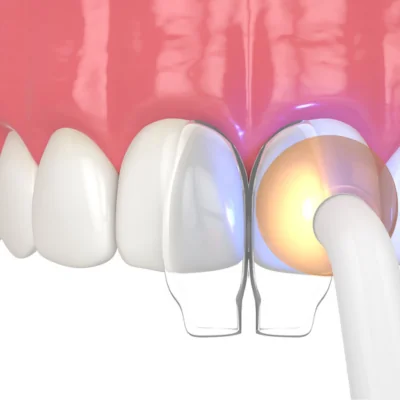
The teeth are then thoroughly cleaned and prepared for bonding. A special dental cement is applied to the back of the veneers, which are then carefully placed onto the teeth. A high-intensity light is used to cure the cement, creating a strong, durable bond between the veneer and the natural tooth structure.
Finally, the dentist will make any final adjustments to the veneers, polishing them to achieve a smooth, natural-looking finish. The result is a stunning, transformed smile that enhances the patient’s overall appearance and self-confidence.
The Benefits of Porcelain Veneers
Porcelain veneers offer numerous benefits to patients seeking to enhance the appearance of their smile:
- Versatility: Porcelain veneers can address a wide range of aesthetic concerns, including chipped, stained, misaligned, or irregularly shaped teeth.
- Durability: With proper care and maintenance, porcelain veneers can last 10–15 years, making them a long-lasting investment in one’s smile.
- Natural appearance: The translucent properties of porcelain closely mimic the appearance of natural tooth enamel.
- Minimally invasive: Compared to other cosmetic dental treatments, such as dental crowns, porcelain veneers require minimal removal of the natural tooth structure.
The integration of digital planning and scanning technology into the porcelain veneer treatment has revolutionised the way cosmetic dentistry is performed. These advanced techniques have streamlined the procedure, enhanced precision, and delivered results that surpass patient expectations.
From digital smile design and intraoral scanning to CAD/CAM technology, these innovations have made achieving a perfect smile more comfortable and efficient than ever before. As dental technology continues to evolve, dental veneer treatments will likely become even more refined, accessible, and transformative.
If you are considering porcelain veneers to enhance the appearance of your smile, it is essential to consult a qualified cosmetic dentist with experience in these advanced digital workflows. With their expertise and cutting-edge technology, you can trust that your journey to a confident smile will be nothing short of exceptional.
Get in Touch
Don’t wait for symptoms to worsen. Book your consultation today and take the first step towards better health.

Call Us: +44 1536 206900
Email Us: info@naturalsmiles.co.uk





© 2026 Natural Smiles Corby | All Rights Reserved | Privacy Policy | Digital Marketing by Remedo